
Churches in the Midst of Polarisation
Date
August 21, 2026 - August 25, 2026Call for papers closed:February 28, 2026Registration closed:June 26, 2026Venue
Where:Utrecht (Netherlands)Adress:Protestant Theological University, Jansdam 14, 3512 HB UtrechtChurches in the Midst of Polarisation
This ecumenical Academic Consultation will critically examine phenomena of polarisation in church and wider society and explore initiatives toward depolarisation. In recent times, political discourse has become increasingly divisive, resulting in palpable tensions and hostility within society. The consultation will address the role of churches and ecumenical organisations in the context of polarising dynamics. It will explore the approaches adopted by these institutions and the manner in which they utilise their positionality. Different types of polarisations, their motives, narratives, dynamics and impact will be examined. This will entail addressing the harm and injustice experienced, and analysing theological responses, and the potential for transformation.
About Consultation
The consultation will discuss the ways in which churches function as colonising or decolonising spaces, and the manner in which theological discourse on gender and identities has been framed in antagonistic terms. The consultation will address the role of symbols and rituals in processes of polarisation and reconciliation. It will also focus on the complex question of truth-seeking amidst conflict and hostility, as a core theological task in the church, as well as in academic and ecumenical spheres. Speakers and participants from a variety of backgrounds and church traditions across Europe will engage in joint analysis and constructive theological reflection.
The following sub-themes will be addressed:
(1) Types of polarisations in churches and in society;
(2) Church as a de/colonising space;
(3) Advocacy or diplomacy: The role of the churches in polarising contexts;
(4) Gender as a de/polarising topic;
(5) Symbol and ritual mediation in reconciling polarisations;
(6) Truth finding in the context of de/polarisation.
Information about the venue, accommodation, and public transport can be found below in section “Venue”.
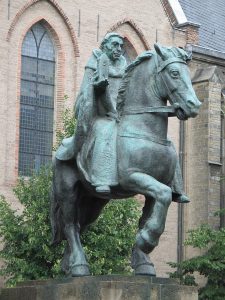
Statue of Saint Willibrord (†739), “apostle of the Frisians”, on Janskerkhof square in Utrecht.
LIST OF SPONSORS
The consultation is held with the support of the following sponsors:
Catharina Halkes Foundation, C.J. de Vogelstichting, Council of Churches in the Netherlands, Marienburgvereniging, Old Catholic Church of the Netherlands, Oud-Katholiek Seminarie, Pro Religione et Libertate Foundation, Protestant Theological University Utrecht, Renovabis e.V., Stichting Oud-Rustenburg, Stichting Sormani Fonds, Tilburg School of Catholic Theology Utrecht, Unie van Baptistengemeenten, Utrecht Theological University, Vrijzinnige Fondsen, Zonneweelde Foundation


Call for papers
Confirmed speakers
Programme
August 21, 2026
Friday
- 14:00 – 16:00, registration for the conference (In de Driehoek, Congress & Meeting Center Utrecht)
- 16:00 – 17:00, opening lecture (In de Driehoek, Congress & Meeting Cente Utrecht)
- Prof. Dr Simone Sinn, Unmasking Polarisation Discourse: Conceptual Clarifications and Learnings from the Ecumenical Movement
- 17:15 – 18:45, plenary session I: “Types of Polarisations in Churches and in Society” (In de Driehoek, Congress & Meeting Center Utrecht)
- 18:55, a welcoming word from Bernd Wallet, Archbishop of Utrecht of the Old Catholic Church of the Netherlands followed by a reception sponsored by the Old Catholic Archdiocese of Utrecht (In de Driehoek, Congress & Meeting Center Utrecht)
- musical performance by Heleen Brüggen (violin), Remi Blokker (violin), and Mia Lodder (viola)
August 22, 2026
Saturday
- 9:00 – 10:30, small papers sessions I (Tilburg School of Catholic Theology Utrecht)
- Section 1, moderated by Mag. Theo. Alexander Heindel (Schedule-and-Abstracts)
- Section 2, moderated by Prof. Dr Johanna Rahner (Schedule-and-Abstracts)
- Section 3, moderated by Rev Jane Stranz (Schedule-and-Abstracts)
- Section 4, moderated by Prof. Dr Hans Burger (Schedule-and-Abstracts)
- 10:30 – 10:45, coffee break (Tilburg School of Catholic Theology Utrecht)
- 10:45 – 12:15, plenary session II: “Church as a De/colonizing Space” (Catharijneconvent Utrecht)
- Dr Masiiwa Ragies Gunda, The Paradoxical (Colonial-Decolonial) Church: Toward an Anti-racism, Decolonial and Inclusive Church (Abstract)
- Dr Alena Höfer, Decolonization between Polarization and Solidarity: Responsibilities and Challenges for Churches Located in the „West“ (Abstract)
- moderated by Prof. Dr Simone Sinn
- 12:15, lunch (Tilburg School of Catholic Theology Utrecht)
- 13:00 – 14:30, plenary session III: “Advocacy or Diplomacy: The Role of the Churches in Polarizing Context” (Catharijneconvent Utrecht)
- Prof. Dr Tim Noble, Singing the Lord’s Song in a Fractured Land (Abstract)
- followed by a discussion with: Dr des. Natallia Vasilevich and Dr Stephen Brown
- moderated by Dr Agnes Slunitschek
- 14:30 – 15:00, coffee break (outside)
- 15:00 – 16:30, plenary session IV – public session: “Democracy and the Rule of Law in a Time of Polarization” (Catharijneconvent Utrecht)
- Prof. Dr Govert J. Buijs (Vrije University), Introduction
- Ms Eunice Anita-Offerman (Samen Kerk in Nederland, SKIN)
- Dr Kees van Ekris (Protestant Church in the Netherlands)
- Prof. Dr Theo de Wit (Tilburg School of Catholic Theology)
- moderated by Mr Geert van Dartel (chair of the Council of Churches in the Netherlands)
- 17:00, common prayer (St Catherine’s Cathedral Utrecht)
- 18:30, dinner (Il Pozzo, Address: Oudegracht a/d Werf 136, Utrecht. For the map, see here)
August 23, 2026
Sunday
- morning, church services
- Baptist: Buurthuis Burezina (service 10:00)
- Address: Jeanne d’Arcdreef 1, Utrecht. For a map, see here
- Greek Orthodox: Church of the Annunciation of the Theotokos (service 9:00)
- Address: Springweg 89, Utrecht. For a map, see here
- Mennonite and Lutheran: Doopsgezinde kerk (combined service 10:00)
- Address: Oudegracht 270, Utrecht. For the map, see here
- Old Catholic: Oud-Katholieke Gertrudiskathedraal (service 10:00)
- Address: Willemsplantsoen 2, Utrecht. For the map, see here
- Reformed (Protestantse Kerk in Nederland): Domkerk (service 10:30)
- Address: Achter de Dom 1, Utrecht. For the map, see here
- Roman Catholic: Catharinakathedraal (service 9:30)
- Address: Lange Nieuwstraat 36, Utrecht. For the map, see here
- Baptist: Buurthuis Burezina (service 10:00)
- lunch (each person on their own)
- 14:00 – 17:30, excursions
- 14:00 – 15:45, all the participants: Museum Catharijneconvent, Lange Nieuwstraat 38, 3512 PH Utrecht. For the map, see here
- in groups (starting for each group at 15:45 at the entrance to the Musem Catharijneconvent)
- Tour of ecclesial Utrecht
- Utrecht Underground tour
- Boat tour of the Utrecht rivers
- dinner (each person on their own)
August 24, 2026
Monday
- 9:00 – 10:30, plenary session V: “Gender and Human Identities as a De/polarising Topic” (Theological University Utrecht)
- Prof. Dr Regina Elsner, Gender Essentialism as Theological Problem and Populist Tool in the Catholic Church (Abstract)
- Dr Pantelis Kalaitzidis, The Theology of “In-Between” and the Role of Women in the Orthodox Church: Orthodox Theology addressing Current Ecclesial Realities (Abstract)
- Dr Mattijs Ploeger, An Icon of Christ: Seeking Common Ground by Understanding the Ordination of Women from the Perspective of Christology, Soteriology and Sacramental Theology (Abstract)
- moderated by Prof. Dr Dimitrios Keramidas
- sponsored by Catharina Halkes Fonds
- 10:30 – 11:00, coffee break (Theological University Utrecht)
- 11:00 – 12:30, plenary session VI: “Symbol and Ritual Mediation in Reconciling Polarisations” (Theological University Utrecht)
- Dr Sam Goyvaerts, The Ambivalence of the Liturgy: Reconciling Ritual, Polarising Practice (Abstract)
- Dr James Hawkey, “The Sign which stands among the peoples”: Excavating and celebrating the dynamic roots of Christian identity (Abstract)
- Dr Edda Wolff, Going through the Motions Together: Embodied Practice as a Path to Reconciliation in Polarized Times (Abstract)
- moderated by Prof. Dr Peter-Ben Smit
- 12:30, common prayer (Theological University Utrecht)
- 13:00, lunch (Protestant Theological University)
- 14:00 – 15:30, small papers sessions II (Protestant Theological University)
- Section 1, moderated by Prof. Dr Marcel Sarot (Schedule-and-Abstracts)
- Section 2, moderated by Rev. Dr Roman Fihas (Schedule-and-Abstracts)
- Section 3, moderated by Ms Nausikaa Haupt (Schedule-and-Abstracts)
- Section 4, moderated by Prof. Dr Stefan Höschele (Schedule-and-Abstracts)
- 15:30 – 16:00, coffee break (“coffee to go” while walking to the Theological University Utrecht)
- 16:00 – 16:30, news on ecumenical research and events (Theological University Utrecht).
- Note: Anyone wishing to speak must notify the president, Prof. Dr Simone Sinn, in advance. The length of each announcement is a maximum of 3 minutes.
- 16:30 – 18:30, membership assembly (Theological University Utrecht)
- 18:45, dinner (KARAF Food & Drinks, Adress: Korte Jansstraat 13-15, Utrecht. For the map, see here)
August 25, 2026
Tuesday
- 9:00 – 10:30, small paper sessions III (Theological University Utrecht)
- Section 1, moderated by Dr. Pascale Jung (Schedule-and-Abstracts)
- Section 2, moderated by Prof. Dr Angela Berlis (Schedule-and-Abstracts)
- Section 3, moderated by Ms Rieke Brouwer (Schedule-and-Abstracts)
- Section 4, moderated by Rev. Dr Erik Berggren (Schedule-and-Abstracts)
- 10:30 – 11:00, coffee break (Theological University Utrecht)
- 11:00 – 12:30, plenary session VII: “Truth Finding in the Context of De/polarisation” (Theological University Utrecht)
- 12:30, common prayer (Theological University Utrecht)
- 13:00, lunch (Theological University Utrecht)
Venues:
The conference will be held at various venues provided by the partner organizations.
- In de Driehoek, Congress & Meeting Center Utrecht, Willemsplantsoen 1 C, 3511 LA Utrecht. For a map, see here
- Theological University Utrecht, Plompetorengracht 3, 3512 CA Utrecht. For a map, see here
- Tilburg School of Catholic Theology Utrecht, Nieuwegracht 65, 3512 LG Utrecht. For a map, see here
- Catharijneconvent Utrecht, Lange Nieuwstraat 38, 3512 PH Utrecht. For a map se here
- Protestant Theological University Utrecht, Jansdam 14, 3512 HB Utrecht. For a map, see here
Accommodations:
Participants will be responsible for booking their own accommodation in Utrecht. Early booking is recommended.
Regular options in the city are:
- Van der Valk Hotel de Bilt, https://booking-v5.vandervalkonline.com/hotel-de-bilt-utrecht/configuration?promotionCode=BIL-SOC-OEC
- Van der Valk Hotel Utrecht, https://www.vandervalkhotelutrecht.com/
- NH Hotel Utrecht, https:/https://www.nh-hotels.com/en/hotel/nh-utrecht
- Holiday Inn Utrecht, https://1url.cz/@ihgcom
- Hello Stay Utrecht, https://hello-stay.nl/
- Bastion Hotel Utrecht, https://www.bastionhotels.com/en-gb/hotels/hotel-utrecht
Budget (and very basic) options are:
- Bunk Utrecht; https://wearebunk.com/utrecht – discount code: UTRUNI
- Stay OK Utrecht Centrum; https://www.stayokay.com/en/hostel/utrecht-centrum – discount code: UU
AirBnB options can be explored individually.
Travel to/in Utrecht:
Getting to Utrecht is simple thanks to its excellent transport connections. If you are traveling by train, most international and domestic routes arrive at Utrecht Centraal, the largest railway station in the country, located right in the city center. From there, our conference venues are within walking distance (and easily reachable by bus and tram).
If you are arriving by plane, the nearest airport is Amsterdam Airport Schiphol. From Schiphol, you can take a direct train to Utrecht Centraal, which runs several times per hour, takes around 30 minutes, and costs approximately €12 per person. The train is generally the best option: it is fast, reliable, and significantly more affordable than traveling by car.
Alternatively, taxis are available directly outside the airport. A taxi ride to Utrecht typically takes around 40–50 minutes and costs on average between €75 and €95.
Public transport in the Netherlands, including Utrecht, is generally very well organized. Trains, buses, trams, and metros can all be used with an OV-chipkaart or simply by checking in and out with a debit or credit card. For more information on how this works, please visit: https://www.ns.nl/en/travel-information/check-in-check-out/debit-card (note that what is explained there for trains also applies to other forms of public transport).To plan your journey, you can use https://9292.nl/en/ or https://www.ns.nl, both of which provide up-to-date travel information for trains as well as other forms of public transport. Other navigation apps can of course also be used.CODE OF CONDUCT
for Participants in the 23rd Academic Consultation of
SOCIETAS OECUMENICA
THE EUROPEAN SOCIETY FOR ECUMENICAL RESEARCH
in Utrecht, August 21-25, 2026
[Approved by the Membership Assembly, as of 2024-09-09]This document is intended for participants of the Academic Consultation organized by Societas Oecumenica to facilitate compliance with the Societas Oecumenica’s Code of Conduct, and to provide a procedure for handling possible infringements.
At the meeting there will be two appropriately equipped persons (male and female) on site who are appointed as a “Response Team” by the Standing Committee (not being members of it). You may contact them either by sending them e-mail to: codeofconduct@societasoecumenica.net, or directly:Sara GEHLIN, e-mail: sara.gehlin@ehs.se, phone: +46 703 569 533
Hector SCERRI, e-mail: hector.scerri@um.edu.mt, phone: +356 7965 1710
Preamble
Each human being has dignity and therefore needs to be respected and protected. This fundamental insight needs to be expressed coherently in the ways we meet and interact in events that bring us together. Basic ethical commitments and standards are to be lived out in the work of the Societas Oecumenica. These include:
- Respect for the dignity and integrity of all human beings.
- Fair and just treatment of all, without discrimination, exploitation, or harassment.
- Responsible stewardship in the exercise of power and use of financial and other resources.
- Respect for diversity, inclusiveness and participation, and transparency and accountability.
All participants are expected to comply with these commitments.
These commitments to human dignity call for special attention in international and multicultural work contexts where differences based on for instance ethnicity, religion, gender, sexual orientation, age, or disability can lead to attitudes or practices that violate individuals’ personal integrity or sense of what is appropriate.
The temptations to misuse power, harass and exploit others, also in relation to sexuality, are considerable, and therefore must be constrained. The Societas Oecumenica’s Code of Conduct embodies zero tolerance with regards to sexual exploitation and abuse, harassment, abuse of power, fraud and corruption in all events and applies rules for any breaches or violations. No one should be subjected to any misconduct from any participant. Therefore, all participants are called upon to:
- Treat all persons fairly and with respect, courtesy, and dignity.
- Behave respectfully towards others and do not misuse private, professional or any other relationships.
- Be aware of the special responsibility that any person in authority has.
- Be mindful of relationships of dependence.
- Be sensitive to cultural and social differences and practices.
Commitment
As a participant in the Societas Oecumenica’s Academic Consultation, I commit to:
- Do not cross boundaries set by others. If someone indicates “No”, even without words, respect it. Avoid any inappropriate gesture or contact.
- Respect and promote fundamental rights of each person, without discrimination.
- Avoid any behavior that is considered an offense under Criminal law or maybe legally understood as abuse, exploitation, misconduct, or sexual harassment.
- Declare conflicts of interest and follow ethical and legally acceptable organizational and business practices.
- Avoid using or encouraging others to use alcohol or other substances in a way that affects their ability to carry out their role.
- Do not exchange money, goods, or services for any kind of sexual favors.
- Never commit any act of fraud, corruption, or unethical business practice, including conflict of interest during Societas Oecumenica events.
- Do not falsely accuse people of harassment or exploitation of any kind for your own advantage.
In all cases International human rights law and the law of the country where the Academic Consultation of the Societas Oecumenica takes place apply.
Procedure
The Standing Committee will have introduced the Response Team on the Code of Conduct and the procedures to follow before the meeting.
At the beginning of the meeting (first session), the organizers will remind all participants about the Code of Conduct. The Response Team should be introduced.
Should anyone need to make a complaint, the following procedures shall apply:
- Approach a member of the Response Team at this event or fill out the Complaint Form.
- Hand the filled-out Complaint Form to any member of the Response Team or send it to codeofconduct@societasoecumenica.net.
- Complaints can be handed in until six months after the conference.
All complaints should be carefully and promptly investigated, meeting privately with the subject of complaint and the complainant (person making the complaint).
For the complainant and subject of complaint, counseling, pastoral care, and accompaniments made available.
The Response Team reports to the Standing Committee of the Societas Oecumenica which makes the decision about the necessary actions.
The Standing Committee may, in its sole discretion, find it necessary to remove the subject of the complaint from the meeting or bar the person from situations where the offence could be repeated. The subject of the complaint shall be informed of the decision.
In cases where the complainant wishes to consider reporting the incident to the relevant legal and/or ecclesial authorities, he or she shall be offered pastoral support in considering such report. However, if the person decides to pursue legal action against the subject of complaint, Societas Oecumenica, as an organization, can in no case be held liable, directly or indirectly, for such act and its possible prejudicial consequences.